


Dentures in Langdon, AB
Dentures Near You
Losing some or all of your natural teeth doesn’t mean losing your smile, your confidence, or your ability to eat the foods you love. At Langdon Dental, we offer a full range of denture solutions — from traditional removable dentures to advanced implant-supported options — built around your anatomy, your lifestyle, and your budget. Every denture we provide starts with a thorough exam and a digital, minimally invasive planning process designed to give you a natural, comfortable, long-lasting result.
Why are Dentures Necessary?
Patients may require a denture if they are missing all or most of their own teeth. This can arise because of aging, oral trauma, gum disease, sports accidents, tooth extractions, or other general health conditions.
Alongside impacting the aesthetic of your smile, missing teeth can lead to problems biting and chewing food and talking clearly and can trigger alignment problems.
Therefore, it is worth exploring getting dentures if you want to improve your smile and how it functions. Consult a dentist in Langdon, AB, to learn more about what options are available.
What Types of Dentures are Available?
Complete (Full) Dentures
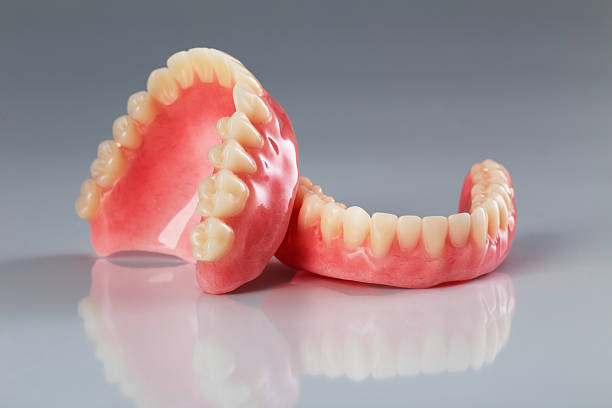
For patients who are missing all of their upper or lower teeth, a complete denture is a removable appliance that restores your full smile and bite function. Modern dentures are far more natural-looking and comfortable than dentures of the past, with lifelike acrylic teeth and gum-colored bases custom-shaded to match your skin tone and facial features.
Partial Dentures
If you still have some healthy natural teeth remaining, a removable partial denture fills the gaps left by missing teeth while using your existing teeth for support. Partials are typically built on a lightweight metal or flexible framework with clasps that anchor discreetly to your remaining teeth.
Implant-Supported (Overdenture) Dentures
For patients who want significantly more stability than a traditional denture can offer, we place a small number of dental implants — usually two to four — into the jawbone. Your denture then clips or snaps onto these implants, dramatically reducing movement, slipping, and the need for denture adhesive. This option preserves jawbone better than a conventional denture and is still removable for cleaning.
Implant-Supported Fixed Dentures (All-on-X)
For patients who want a permanent, non-removable solution, we offer full-arch, implant-supported fixed dentures using the Neodent GM Helix implant system. With as few as four to six strategically placed implants per arch — guided by 3D CBCT imaging and computer-designed surgical guides — we can often provide a fixed set of teeth in as little as one day. This is the closest option to having your natural teeth back: no removal for cleaning, no slipping, and full chewing function.
Choosing the right option depends on how many teeth you’re missing, the health and volume of your jawbone, your budget, and how much stability and permanence matter to you. We’ll walk through all of this together during your consultation.
What the Treatment Entails
What to Expect: Your Denture Journey
1. Comprehensive Examination
Your first visit starts with a complete assessment of your oral health, including your remaining teeth (if any), gum tissue, jawbone, and bite. We’ll talk through your goals, your concerns, and what kind of denture solution makes the most sense for your situation.
2. Oral Cancer Screening
Every new denture patient receives a thorough oral cancer screening as part of their exam. We check the soft tissues of your mouth, tongue, throat, and neck for any unusual changes. This is a routine, painless, and important part of responsible dental care — especially before undertaking a larger restorative treatment like dentures.
3. Digital Scans and Imaging
Rather than the messy, uncomfortable impression trays of the past, we use digital scanning technology to capture a precise, 3D map of your mouth. If implants are being considered, we also take a CBCT (3D) scan of your jaw to evaluate bone volume, density, and the location of important anatomical structures like nerves and sinuses. This data allows us to plan your treatment with a level of precision that wasn’t possible even a few years ago.
4. 3D Mock-Up and Smile Design
Before any final denture is made, we design a digital mock-up of your new smile. This lets you preview your tooth shape, size, shade, and overall smile aesthetics — and gives us a chance to make adjustments together before anything is finalized. For implant cases, this digital plan also guides the exact placement of each implant.
5. Assessing Your Vertical Dimension
One of the most important — and most often overlooked — steps in denture treatment is establishing the correct vertical dimension of occlusion: essentially, how far apart your jaws sit when your teeth come together. Get this wrong, and patients can end up with a sunken, “collapsed” facial appearance, jaw discomfort, or difficulty chewing. Get it right, and the result supports your natural facial proportions, improves your bite efficiency, and feels comfortable. We carefully measure and verify this dimension using facial landmarks, phonetics (how you speak), and bite registration before your final denture is fabricated.
6. Fabrication and Try-In
Depending on the type of denture, you may have one or more try-in appointments where we check fit, appearance, bite, and speech before the denture is finalized. For same-day implant options, this process is compressed using our digital and CAD/CAM technology.
7. Delivery and Adjustment
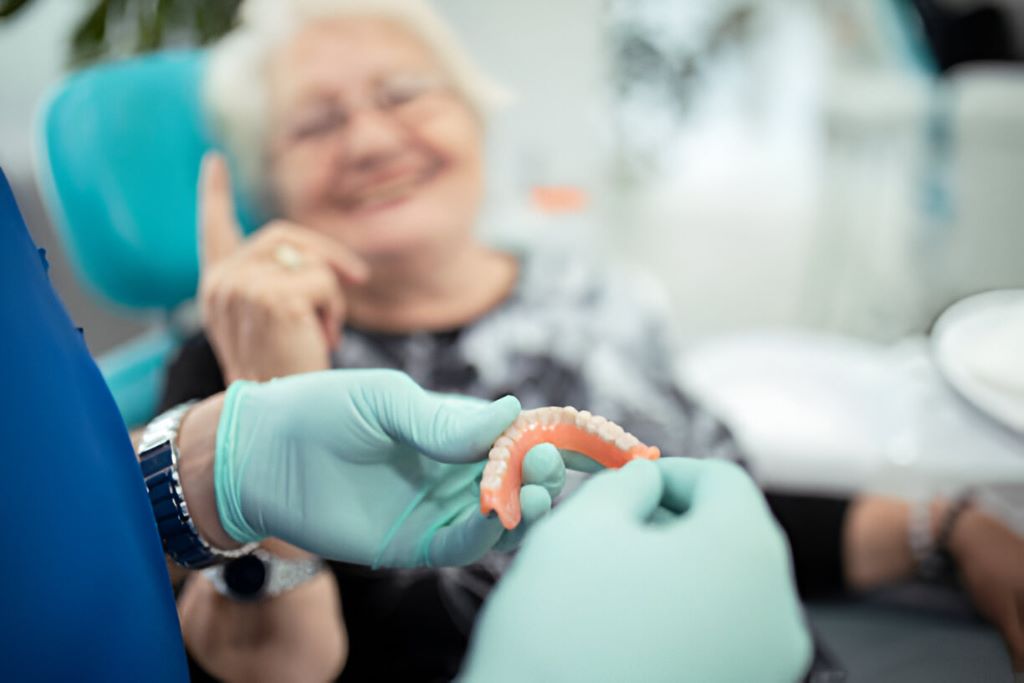
Once your denture is complete, we’ll fit it, review how to insert and remove it (if removable), and go over care instructions. A short adjustment period is normal as your mouth and muscles adapt.
Understanding Denture Relines
Over time, your jawbone and gum tissue naturally change shape — this is a normal part of healing and aging, especially after tooth loss. As this happens, a denture that once fit snugly can become loose, causing irritation, slipping, or difficulty chewing.
A reline is the process of refitting the underside of your existing denture to match your current gum and bone contours, without replacing the entire appliance. There are a few types:
- Soft Reline: A cushioning material is added to the inside of the denture, often used for patients with sensitive gum tissue or for those adjusting to a new denture.
- Hard Reline: A more durable, permanent-style material is used to restore a precise fit for long-term wear.
- Rebase: The entire base of the denture is replaced while keeping the existing (still good) denture teeth — typically used when the base has worn out but the teeth themselves are still in good shape.
Most conventional dentures need a reline every one to two years, though this varies from patient to patient. Regular check-ups allow us to catch fit issues early, before they lead to sore spots, bone loss, or bite problems.
Caring for Your Dentures
Whether removable or implant-supported and fixed, dentures require daily cleaning and regular professional check-ups to keep your mouth healthy and your denture functioning well. We’ll provide personalized home care instructions based on the type of denture you choose, along with a recommended recall schedule to monitor fit, function, and the health of your gums and jawbone over time.

Restore Your Smile with Custom Dentures
If you think you might benefit from complete or partial dentures near you, call us today at Langdon Dental. We’d be happy to schedule you for a consultation with our dentist and assist you with all your dental needs.
We hope to see you very soon!
Easily locate Langdon Dental on Google Maps – your trusted dental clinic in Langdon for comfortable and natural-looking dentures.